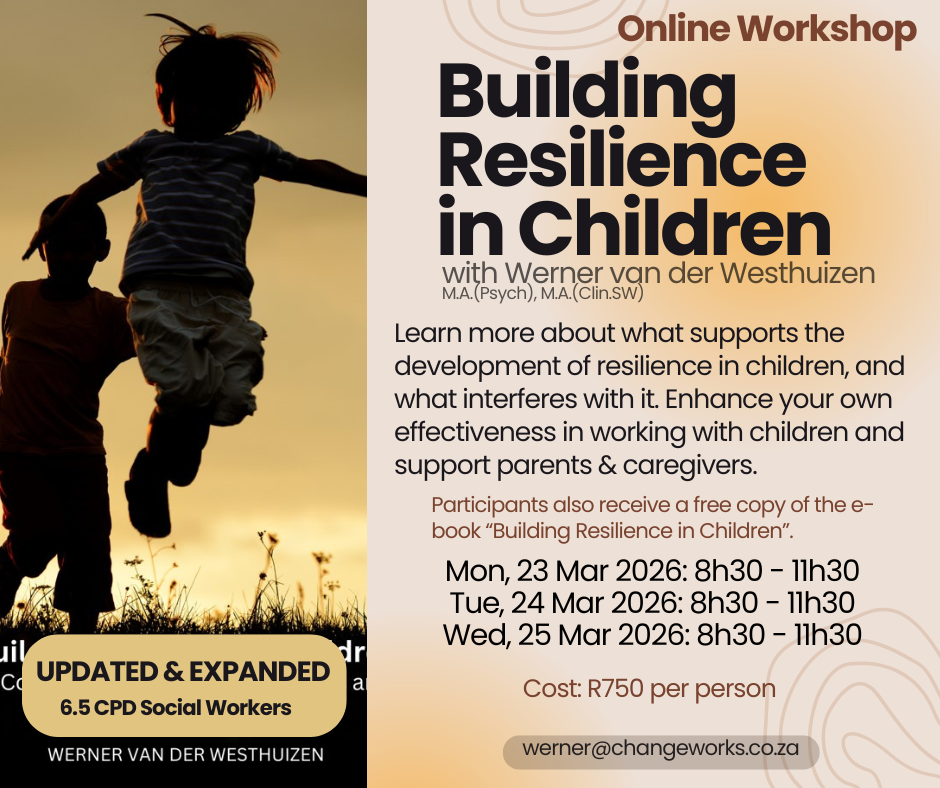
Resilience is a critical ability for children to develop as it helps them cope with challenges, adversity and stress. Social workers and auxiliary workers play a virtal role in supporting children’s resilience by empowering children, fostering positive relationships and teaching children and parents coping skills.
This workshop is designed for social workers and social auxiliary workers. The workshop is being expanded and updated for 2026, and a new CPD application will be made which is expected to carry more CPD points than the previously approved 5 points.
In this workshop you will unpack the term “resilience” and explore the essential skills that children need to navigate the challenges in their world successfully. Whether you are working directly with children and young people, or supporting parents and caregivers, your intervention or care plan will include aspects of building resilience, because it is a foundation needed for clients to achieve their developmental outcomes.
Contents of the Workshop
The workshop starts by introducing the participants to the concept of resilience and what is considered to be its building blocks. The role of the caregiver and caregiver relationships receive particular attention and myths about resilience are debunked. A brief overview of the Birth to 20 Plus study provides a South African context for adversity and trauma and the relevance of proactively strengthening resilience in children. The neurobiology of resilience and the importance of secure attachments in children are also explored.

The contents for this workshop is based on the book “Building Resilience in Children” by Werner van der Westhuizen
As the workshop proceeds, the focus is deepened and specific skills for fostering resilience are covered, including strategies for teaching children affect regulation, effective social skills and cognitive skills such as problem solving and decision making. Finally, participants are invited to explore how resilience can be strengthening in two contexts, namely the home environment and at school. This includes a brief exploration of the importance of planned environments, and how caregivers can partner with teachers to collaborate on building resilience in children.
Finally, the focus shifts to the effectiveness of the professional and themes of self-care are explored in relation to the resilience of the professional (or caregiver) and how adult attachment styles may influence interventions with children. Ethics are explored in more detail, with an emphasis on cultural relevance and sensitivity and the role that power dynamics may play in the development of resilience, especially in school contexts. Finally, the workshop is concluded, and participants are invited to complete an assignment (at their own pace) to finalise their participation in the workshop.
Dates and times for the next workshop:
- Monday, 23 March 2026: 8h30 – 11h30
- Tuesday, 24 March 2026: 8h30 – 11h30
- Wednesday, 25 March 2026: 8h30 – 10h30
The cost is R750 per person.
The workshop is facilitated fully online via Zoom. Participants are required to remain on camera for the full duration of each session and should ensure that their equipment and internet connection is suitable for this kind of interaction. It is recommended that each participant should attend from a suitable physical space (for example, not while travelling or while sharing office space with others). The use of headphones is recommended.
If you have any questions, please contact Werner at werner@changeworks.co.za.
Please read our Terms & Conditions