
Family Strengthening Workshops
Family Empowerment & Community Empowerment
Workshops for Social Workers, Community Development Workers,
Child & Youth Care Practitioners and Everyone Who Works to Empowerment Families
Would you like to be informed when a workshop is confirmed to take place? Register your interest (no commitment needed) and you will be informed once any arrangements are made.
Why Family Strengthening is Essential
The family is “the fundamental group of society and the natural environment for the growth and well-being of all its members and particularly children” (United Nations, 1989). Family strengthening (FS) services focus on preventing child-family separation and addressing its underlying causes to ensure that children’s and young people’s rights are fully realised within their family of origin.
Family strengthening services consist of two approaches: direct family empowerment (DFE) and community empowerment for family empowerment (CFE). Both approaches are based on working towards the shared aim of family empowerment, and building inclusive and equal partnerships with local stakeholders, including public authorities, to ensure locally relevant and coordinated service delivery.
Care reform and family strengthening are interconnected approaches to child welfare. Care reform focuses on transforming institutional care systems by reducing reliance on orphanages and residential facilities, while family strengthening aims to prevent family separation and support vulnerable families.
The key link is that effective care reform requires robust family strengthening as its foundation. When families receive adequate support – through economic assistance, parenting programmes, mental health services, and community resources – children can remain safely at home rather than entering care systems. This prevents unnecessary institutionalization.
How are the Workshops Structured?
Two main workshops are available:
- Family Empowerment Workshop (Approved by SACSSP for 19 CPD for Social Workers & Social Auxiliary Workers)
This workshop focuses on direct support services to children and their families with the aim to prevent child-family separation by directly strengthening the capacity of caregivers to provide quality care. - Community Empowerment Workshop (Approved by SACSSP for 16 CPD for Social Workers & Social Auxiliary Workers)
This workshop focuses on community development and empowerment as a strategy to empower families whereby practitioners mainly engage with community-based structures and resources. Community Empowerment aims to prevent child-family separation by strengthening the capacity of caregivers to provide quality care, and building partnerships with stakeholders to ensure locally relevant and coordinated service delivery.
Depending on the focus of the practitioner, they may attend one, or both of these workshops. For example, those working directly with young people and families might attend only the Family Empowerment workshop, and likewise the Community Empowerment workshop for community-focused practitioners. However, family strengthening often combines family- and community-based interventions, so for the best impact, participants are encouraged to attend both.
Both workshops can be delivered either in-person or fully online.
Participants are provided with full workshop notes.
Workshops are divided into several 90-minute sessions. These can be delivered individually over time – for example, once a week across several weeks – or combined into multiple sessions to fill a morning, an afternoon, or even a full day in the case of in-person workshops.
Workshop participants include pre-session preparation (for example, reading or reviewing content), workshop session attendance and participantion, and post-session reflection (for example, reflecting on the content covered and completing a learning journal). The time investment is therefore considerably more than the time allocated to session attendance, and participants should reflect on their availability before committing to the workshop.
The workshop follows a flipped classroom approach. Content in the form of a manual is provided to participants ahead of the workshop, which contains self-study material and reflective exercises that must be completed before each session – ensuring that workshop sessions can focus on integration of the content and implementation in practice. Workshop sessions therefore do not necessarily repeat the content, and this workshop series is best suited for adult learners who are serious about their professional development.
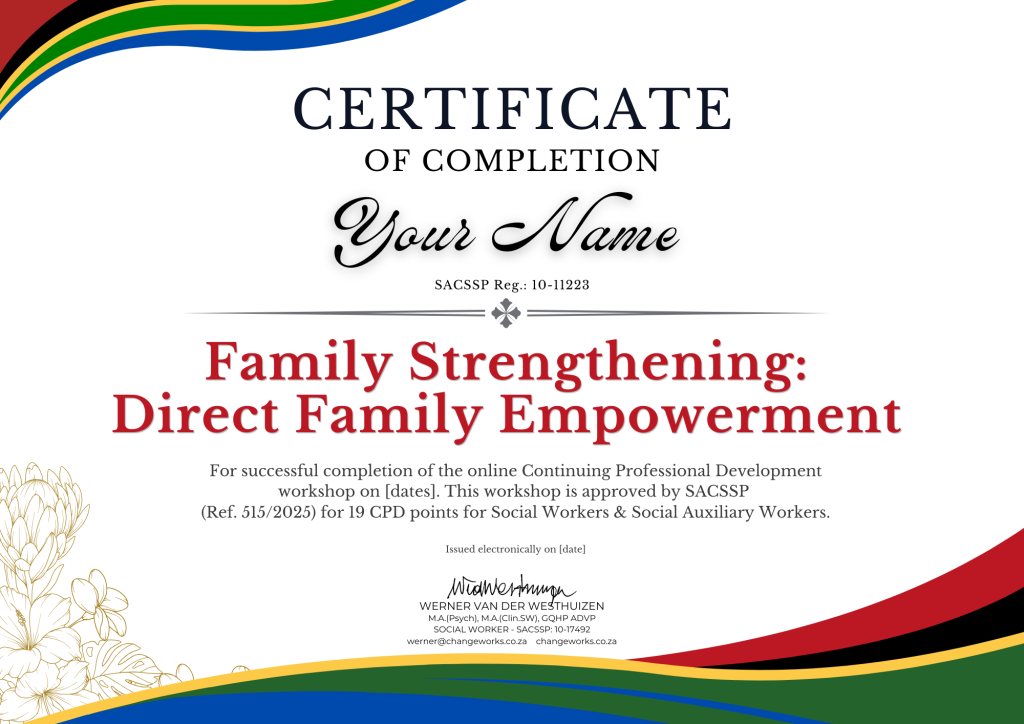
Upon completion of the workshop, participants will receive a certificate of completion for Continuing Professional Development purposes.
Who Should Attend?
The Family Strengthening workshops are relevant for:
- Social Workers, especially those who supervise or support practitioners rendering services to young people, families and communities
- Social Auxiliary Workers who directly deliver services to young people and families in communities
- Child & Youth Care Practitioners who supervise or support practitioners rendering services to young people, families and communities, or who provide direct services to families and communities
- Community Development Workers who focus on community-based services to strengthen families
- Community Volunteers who may support direct services to families or community-level services
Anyone who works in a formal or informal capacity to empower families and communities can benefit from attending the Family Strengthening workshops. The content is developed with an international audience in mind, although it is approved as Continuing Professional Development workshops with the South African Council for Social Service Professions.
Family Empowerment Workshop (Workshop 1)
Below follows a brief outline of the content for this workshop:
Session 1: Introduction to a modern learning and development approach
Session 2: Values and attitudes in direct work with families
Session 3: The case management approach
Session 4: Assessing the situation of families
Session 5: The collaborative development of family development plans
Session 6: Facilitating support for families
Session 7: Providing direct support to families
Session 8: On-going support of families and follow-up
Session 9: Advocating for families
Session 10: Supporting families and young people through reintegration
Session 11: Working with the multidisciplinary team
Session 12: Gender-transformative family strengthening services
Session 13: Ethics in action
Session 14: Consolidating learning and closure
Each workshop session has three parts: pre-session preparation (reading or content review), a 90-minute live facilitated session, and post-session reflection and evaluation, including an entry in a learning journal.
For organisations and groups, sessions can be arranged to suit your needs. You might run one session per week over several weeks to maximise practice and integration, or combine several sessions within a day or week for a more compact, accelerated experience.
Community Empowerment Workshop (Workshop 2)
Below follows a brief outline of the content for this workshop:
Session 1: Introduction to a modern learning and development approach
Session 2: Relational practice in family strengthening
Session 3: Assessing community capacity
Session 4: Identifying key implementation partners
Session 5: Capacitating key implementation partners
Session 6: Strengthening networks and partnerships
Session 7: Advocating for services and resources
Session 8: Raising community awareness
Session 9: Facilitating and participating in meetings
Session 10: Facilitating groups
Session 11: Facilitating workshops
Session 12: Promoting a case management approach
Session 13: Consolidating learning and closure
Each workshop session has three parts: pre-session preparation (reading or content review), a 90-minute live facilitated session, and post-session reflection and evaluation, including an entry in a learning journal.
For organisations and groups, sessions can be arranged to suit your needs. You might run one session per week over several weeks to maximise practice and integration, or combine several sessions within a day or week for a more compact, accelerated experience.
Workshop Facilitator

Werner is a Clinical Social Worker registered with the South African Council for Social Service Professions (SACSSP). He offers counselling, consulting and training – with a focus on meaningful, evidence-informed therapeutic work delivered entirely online.
His approach is relational and strengths-based – meeting clients where they are, and helping them build the insight and resources to move forward.
Werner holds master’s degrees in both Psychology and Clinical Social Work, is registered as a Clinical Social Worker with SACSSP and SAASWIPP, and trained in EMDR, NLP and Hypnotherapy.
He brings over 30 years of practice experience to his engagement with clients, and has authored numerous articles, book chapters, and published a book on Building Resilience in Children.
Werner has worked with SOS Children’s Villages International to develop extensive competency frameworks and detailed workshops to train facilitators in aspects of relational child and youth care practice, comprehensive training for caregivers and youth development workers, and family strengthening programmes.
Terms and Conditions
Please review the Terms and Condition for Workshop Participants.