Ready to stop smoking?
You don’t have to do it alone.

You are here because you already decided. Ready to begin?
Message me on WhatsApp: https://wa.me/27825104412
E-mail me at: werner@changeworks.co.za
Why stopping is hard, and why an integrated approach
Many people who smoke or vape have tried to stop before, often several times, without it lasting. That is not a sign of failure or weakness. Most people who eventually quit for good have made several attempts first, and each one builds toward success. This programme may look like a lot. It is deliberately thorough, and meant for someone who is serious about being a non-smoker. The effort is a worthwhile investment with little to lose, and everything to gain.
Most people who smoke or vape already want to stop. They know the risks: the raised chance of heart disease, stroke, lung disease and cancer, the cost, the loss of fitness and freedom, and the example set for children. What they are up against is not simply a bad habit, or a lack of willpower. Nicotine dependence works on three levels at once: it is physical (the body has adapted to nicotine), psychological (smoking is tied to stress, emotion and identity), and habitual (it is woven into daily routines and triggers). It takes root in a person’s body, their daily routines and their social environment.
A treatment that targets only one of these levels tends to fail. This programme is built to address all three together, which is why it combines medical support and psychosocial therapy (or coaching) in one coordinated model, with hypnotherapy available as an option.
What the research supports
The international and South African guidelines agree on one core finding: the most effective approach combines behavioural (psychosocial) support with medical treatment. Each works better alongside the other than either does alone. This is the backbone of the programme.
The approach at a glance
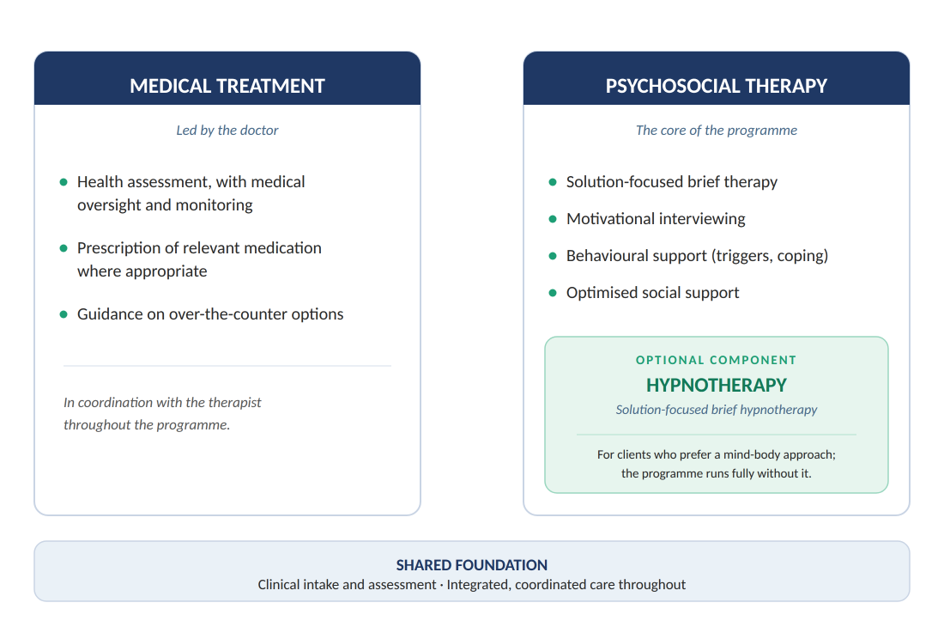
Psychosocial therapy/coaching. The core of the programme and the therapist’s primary work. Psychosocial therapy/coaching helps the client to create realistic goals and outcomes, build a clear picture of life without smoking, strategise to break habitual patterns, draw on strengths they already have, and optimise social support. Practical behavioural work sits here too: identifying triggers, building coping plans, setting a quit date and preventing relapse.
Medical treatment. Delivered by the client’s doctor or a doctor familiar with the programme. Depending on the level of dependence, this may include nicotine replacement therapy (typically a patch combined with a short-acting form such as gum or lozenge), varenicline, or bupropion, together with medical oversight of withdrawal and any other health considerations. The therapist does not prescribe; the doctor leads this pillar entirely.
Hypnotherapy (optional). Offered as an optional component for clients who are drawn to mind-body approaches. Using solution-focused hypnotherapy, the client is guided to access their own internal resources (calm, confidence and a sense of control) and to mentally rehearse themselves as a non-smoker in the situations that once triggered smoking. It grows out of the psychosocial work and deepens it. Clients who prefer not to use hypnotherapy proceed with the medical and psychosocial elements alone – this is not a disadvantage, it is a matter of what suits each individual person best.
Working together: The role of the doctor
This programme is designed to run in partnership with the client’s doctor. Here is how we work together:
- The doctor assesses the client’s suitability for medication, prescribes and manages pharmacotherapy, and monitors the client’s general health through the quit attempt.
- The therapist/coach conducts the intake and dependence assessment, delivers the psychosocial programme and hypnotherapy, and supports the client with motivation, coping and relapse prevention between and beyond medical appointments.
With the client’s consent, the therapist/coach is glad to keep the referring doctor briefly informed of progress. The aim is simple: the client gets medical and behavioural support that pull in the same direction.
The programme in practice
The programme is delivered over a series of sessions rather than a single visit, because stopping a long-established habit realistically takes more than one or two sessions. It begins with a minimum of four sessions, held weekly over about a month. A typical path runs from an initial intake and assessment, through preparation and a chosen quit date, into the active quit phase (optionally supported by hypnotherapy), and on to consolidation and relapse prevention. The number of sessions is tailored to the individual and their level of dependence, and where medication is involved the timing is coordinated with the doctor.
Suitability and honest expectations
The programme suits adults who are motivated to reduce or stop smoking, including those who are not yet fully ready and want help getting there. Where a client presents with significant untreated medical or mental health difficulties, those are addressed or referred appropriately first. Relapse is common on the road to stopping and is treated as part of the process, not as failure: each attempt builds toward lasting change.
Fees
Most medical aid schemes treat smoking cessation as a lifestyle service rather than a medical condition, and therefore do not cover these services.
| Session 1: assessment (90 minutes) | R 1 100 |
| Sessions 2 – 4 | R 850 each |
| Sessions 2 – 4, prepaid package | R 2 000 (save R550) |
| Continuation sessions (if needed) | R 700 each |
| Option 1: Total cost (pay per session): R 3 650 | Option 2: Total cost (prepaid package): R 3 100 |
It may be useful to weigh the cost of the programme against the cost of smoking per month, per year, and potentially a lifetime. The cost of the programme is often recovered within 2 – 3 months of no smoking, and from that point on forward it becomes a monthly saving, in addition to a lifetime’s health benefits.
Frequently asked questions
Do I need a referral from a doctor?
No. You can contact me directly. With your consent, I’ll work with your own doctor, or help you find one, for the medical side of treatment. Sometimes clients choose not to engage medical care, and that is a fair choice – but the evidence points to the combination of these services as critical for good outcomes.
I’ve tried to stop before. Will this be different?
Many people need several attempts before they stop for good, and each one teaches something useful. This programme builds on what you’ve already learnt, with support that’s tailored to you.
I vape rather than smoke. Is this for me?
Yes. The programme is designed for smoking, vaping and dual use.
Do I have to use medication?
No, you don’t have to. However, medication significantly improves the chances of success, so it’s recommended. The decision is made between you and your doctor.
Do I have to be hypnotised?
No. Hypnosis is entirely optional, and the programme works fully without it.
What if things don’t go to plan?
Setbacks are common and can be worked through. The programme includes what to do to get back on course quickly, and further sessions are available if you need them.
About me
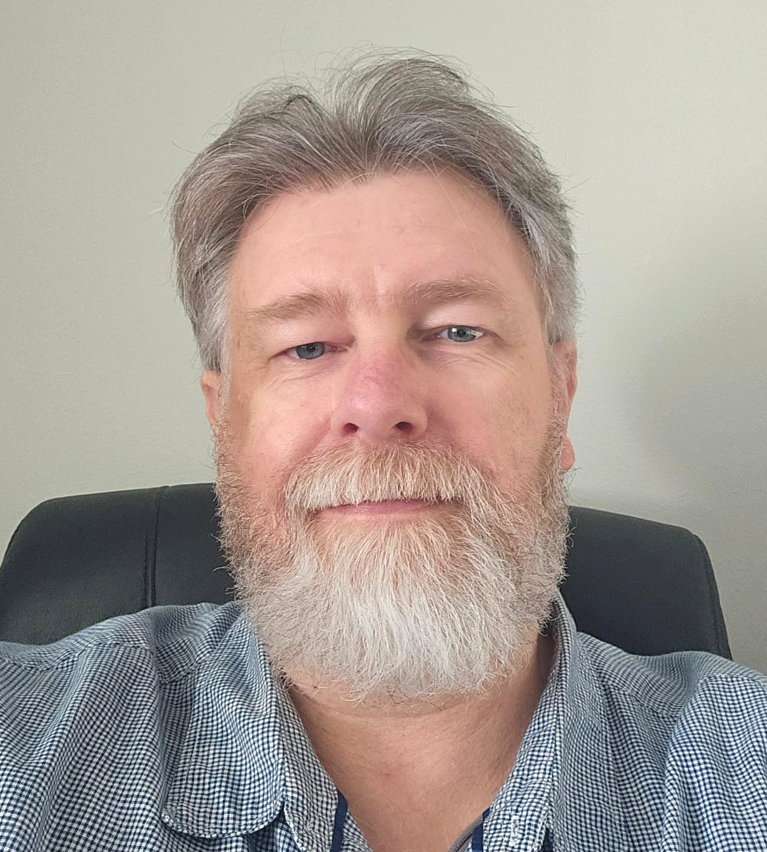
I’m Werner van der Westhuizen, a clinical social worker in private practice in Walmer, Gqeberha. I hold master’s degrees in both clinical social work and psychology, am a certified hypnotherapist, and am registered with the South African Council for Social Service Professions. My approach is practical, warm and solution-focused. I work with you as a person, not a problem, drawing on your own strengths and working closely with your doctor so that you are supported from every side. Sessions are available in English and Afrikaans.
Ready to begin
Message me on WhatsApp: https://wa.me/27825104412
E-mail me at: werner@changeworks.co.za