
Building Resilience: Assessment to Action
A Workshop for Social Workers
You know that many clients lack resilience.
Do you know how to build it?
Move beyond theory into practical tools to help children and families actually
develop the resilience they need, and not just get labelled as not having it.
New dates available soon
Also available on demand for group bookings
Online via Zoom
6.5 CPD for Social Workers
Assessment without Action Leaves Clients Stuck
Have you ever sat across from a client, compiled an assessment, written up the report – and still walked away with a nagging question: now what?
Resilience gets talked about constantly in social work. It’s in our case plans, our supervision notes, our training manuals. But knowing that a child or adult needs to “build resilience” and knowing exactly how to help them build it are two very different skills – and most training stops at the first one.
You didn’t become a social worker to hand out labels. You became one to help people change. This workshop aims to close that gap.
Built for Practitioners Who Want More Than Theory
This workshop is designed for social workers who work directly with children, caregivers, families or adults – whether in child protection, family preservation, schools, NGOs, institutional care or private practice.
If your caseload includes clients who navigate adversity – poverty, family disruption, trauma, loss, instability – resilience isn’t a side topic. It’s the foundation your entire intervention rests on. This workshop explores frameworks and tools to build that foundation deliberately, rather than hoping it develops on its own.
From Theory to Practice – What This Workshop Gives You
This is a practical, evidence-based workshop – not a lecture on definitions. You’ll move through a clear progression: understanding what resilience really is (as both a process and an outcome), how it operates across individual, relational, family, and community levels, and – critically – how to intervene at each of those levels with real tools you can use in your next session.
- Understand resilience through an ecological systems lens – and why “just be more resilient” advice fails
- Explore practical assessment and intervention frameworks across individual, relational, family, and community levels
- Explore multi-level intervention planning tools you can bring into your caseload immediately
- Navigate the ethical grey areas: professional boundaries, genuine participation vs. passive assessment, and prioritising resources under high caseloads
- Balance cultural respect with child wellbeing in resilience-focused practice
- Build confidence delivering resilience-focused interventions that are both evidence-based and ethically grounded
You’ll leave with more than notes – you’ll leave with a way of working.
Overview of the Workshop Content
This workshop offers a practical, evidence-based approach to understanding and building resilience in children and families. Beginning with foundational theory – including ecological systems thinking and the idea of resilience as both process and outcome – participants progress through relational, assessment, and intervention frameworks that address resilience at various level, including individual, relational, family, and community.
By exploring various tools and multi-level intervention planning, participants will develop concrete skills alongside theoretical grounding. Throughout, the workshop weaves in critical ethical reflection: professional boundaries, ensuring genuine participation rather than passive assessment, resource prioritization under high caseloads, and balancing cultural respect with child wellbeing. Ideal for practitioners working with children and families, this workshop combines theory, practice, and ethical grounding to build confident, skilled, culturally responsive resilience-building practice.
Logistics and Investment
Format: Online (Zoom)
Duration: 3 half-days (9h00 – 12h00)
Next Dates: Available soon
CPD Points: 6.5 Points (SACSSP)
Workshop Includes: Workshop Notes, CPD Certificate
Investment: R650 for individual registrations; group tarrifs available on request
Technical Requirements:
This workshop is fully online via Zoom and interactive by design. Please plan to:
- Stay on camera for the full duration of each session
- Join from a PC or laptop (not phone/tablet — some shared materials require a full screen to read)
- Attend from a quiet, private space, ideally with headphones
- Avoid sharing a device with a colleague, so you can participate fully
Don’t Miss Out
This workshop is capped at 20 participants to keep it interactive, so every participant gets real engagement, not a passive lecture. Registration closes on 15 July 2026 or once seats are full – whichever comes first.
If you’re ready to move from assessing resilience to actually building it, this is your next step.
Questions before you register? Contact werner@changeworks.co.za – happy to help.
Your Facilitator

Werner van der Westhuizen is a Clinical Social Worker registered with the South African Council for Social Service Professions (SACSSP), with over 30 years of practice experience. He holds master’s degrees in both Psychology and Clinical Social Work, and is also registered with SAASWIPP.
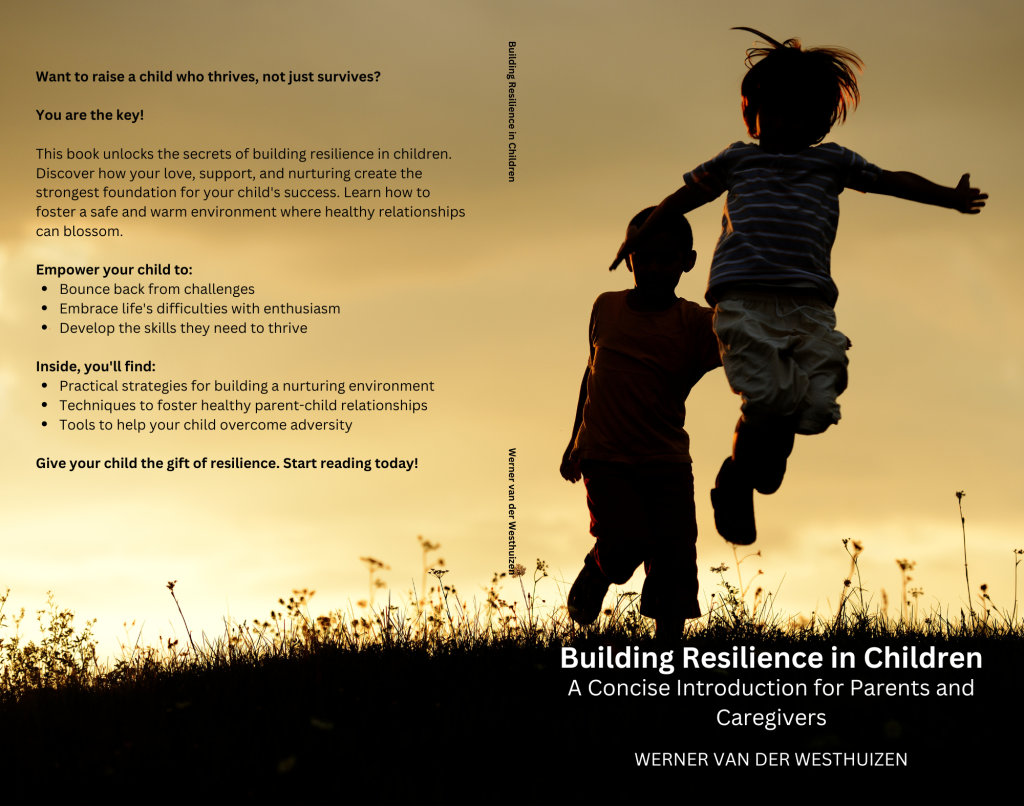
His approach is relational and strengths-based – meeting clients where they are, and helping them build the insight and resources to move forward. He is trained in EMDR, NLP, and Hypnotherapy, and has authored numerous articles and book chapters, including a published book on Building Resilience in Children – the foundation this workshop is built on.
Workshop Terms & Conditions
Please review the Workshop Terms and Conditions: