
Build The Confidence To Respond When It Matters Most
Crisis Intervention
Workshop
As a social worker or auxiliary social worker, you face high-stakes situations where your response can change lives. Whether it’s a child in acute distress, a family in chaos, or a colleague on the edge of burnout, the ability to intervene effectively during crisis moments is essential.
Social workers are increasingly called into sisutations that require immediate, skilled crisis response – often in dangerous situations – yet may feel unprepared for this challenge
This Crisis Intervention Workshop gives you practical, evidence-based strategies you can use immediately. You’ll learn how to de-escalate volatile situations, assess risk accurately, support trauma survivors in their most vulnerable moments, and protect your own wellbeing while doing this demanding work.
We know your time is limited and your caseload is full. That’s why this workshop focuses on real-world scenarios you encounter daily, not abstract theory. You’ll leave with a toolkit of techniques that work when it matters most.
The families and children you serve deserve professionals who are confident and skilled in crisis response. You deserve the training and support to do this work sustainably.
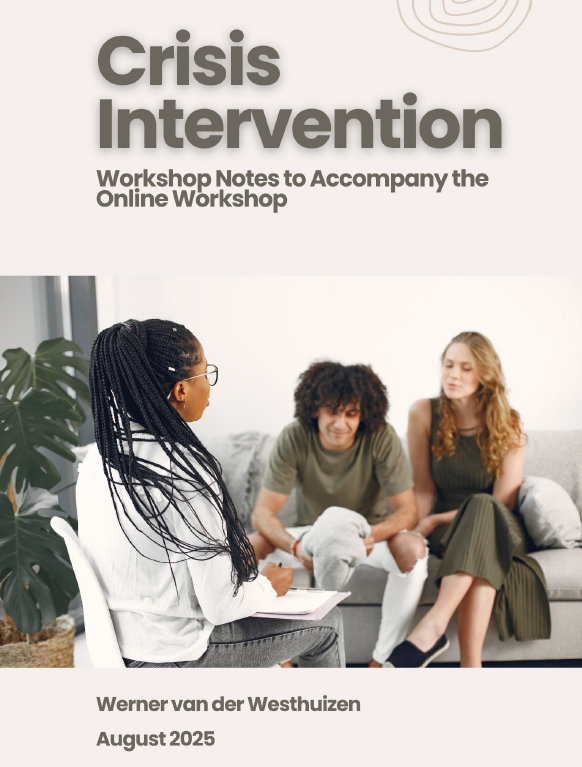
The workshop begins with an introduction to crisis intervention and its effects on individuals and families, followed by an exploration of crisis theory and various intervention models. The emphasis is not on mastering a specific model, but on understanding the common principles across these models to support an integrative approach.
The sessions include ample opportunities for group exercises, case discussions, and practical examples, allowing participants to apply theoretical concepts to real-life scenarios. Presentations and exercises cover de-escalation and calming techniques for situations of imminent danger, as well as in therapeutic contexts.
The focus however, remains on working with clients who are overwhelmed in the moment and unable to engage with problem solving at the time. Ethical considerations are also highlighted through both presentations and group activities.
Logistics and Investment
Format: Online (Zoom)
Duration: 2 half-days (8h30 – 13h00)
Next Dates:
- Monday, 17 August 2026 (8h30 – 13h00)
- Tuesday, 18 August 2026 (8h30 – 13h00)
CPD Points: 10 (SACSSP) for Social Workers & Social Auxiliary Workers
Includes: Workshop Notes, CPD Certificate
Investment:
- Individual registration: R750 per person
- Register 2 or more people: R500 per person (Single payment by primary registrant)
Technical Requirements:
The workshop is facilitated fully online via Zoom. Participants are required to remain on camera for the full duration of each session and should ensure that their equipment and internet connection is suitable for this kind of interaction. Attendance with a phone or tablet isnot recommended – it is recommended to use a PC or laptop since some of the screens that will be shared may include text or diagrams that would be too small to read on a cellphone screen. It is recommended that each participant should attend from a suitable physical space (for example, not while travelling or while sharing office space with others). The use of headphones is recommended – alternatively participants should be in a space not shared with others. It is not ideal for participants to share a device, since it will limit their interaction and participation.
Your Facilitator

Werner is a Clinical Social Worker registered with the South African Council for Social Service Professions (SACSSP). He offers counselling, consulting and training – with a focus on meaningful, evidence-informed therapeutic work delivered entirely online.
His approach is relational and strengths-based – meeting clients where they are, and helping them build the insight and resources to move forward.
Werner holds master’s degrees in both Psychology and Clinical Social Work, is registered as a Clinical Social Worker with SACSSP and SAASWIPP, and trained in EMDR, NLP and Hypnotherapy.
He brings over 30 years of practice experience to his engagement with clients, and has authored numerous articles, book chapters, and published a book on Building Resilience in Children.
Frequently Asked Questions
What specific crisis intervention models will be covered?
The workshop reviews several crisis intervention models and draws out the elements they have in common, using those shared principles as the foundation for a unified approach.
Is this workshop suitable for both beginners and experienced practitioners?
Yes. For early-career professionals, it provides a foundational blueprint for navigating high-stakes situations safely. For seasoned practitioners, the workshop offers an opportunity to review existing knowledge and skills, reflect on current issues and challenges, and integrate fresh perspectives on modern crisis challenges.
What is the cancellation policy?
We keep our cancellation policy simple: no financial penalties, just a commitment to being responsible and respectful. When you register, take a moment to make sure you can genuinely attend — your spot counts toward the minimum needed to run the workshop and has a real impact on the group and the facilitator’s preparation. Life happens, and if you absolutely must cancel, please reach out to the facilitator in advance rather than leaving them and the group without word.
Terms & Conditions
Please take a minute to review our terms and conditions which apply to all participants: